

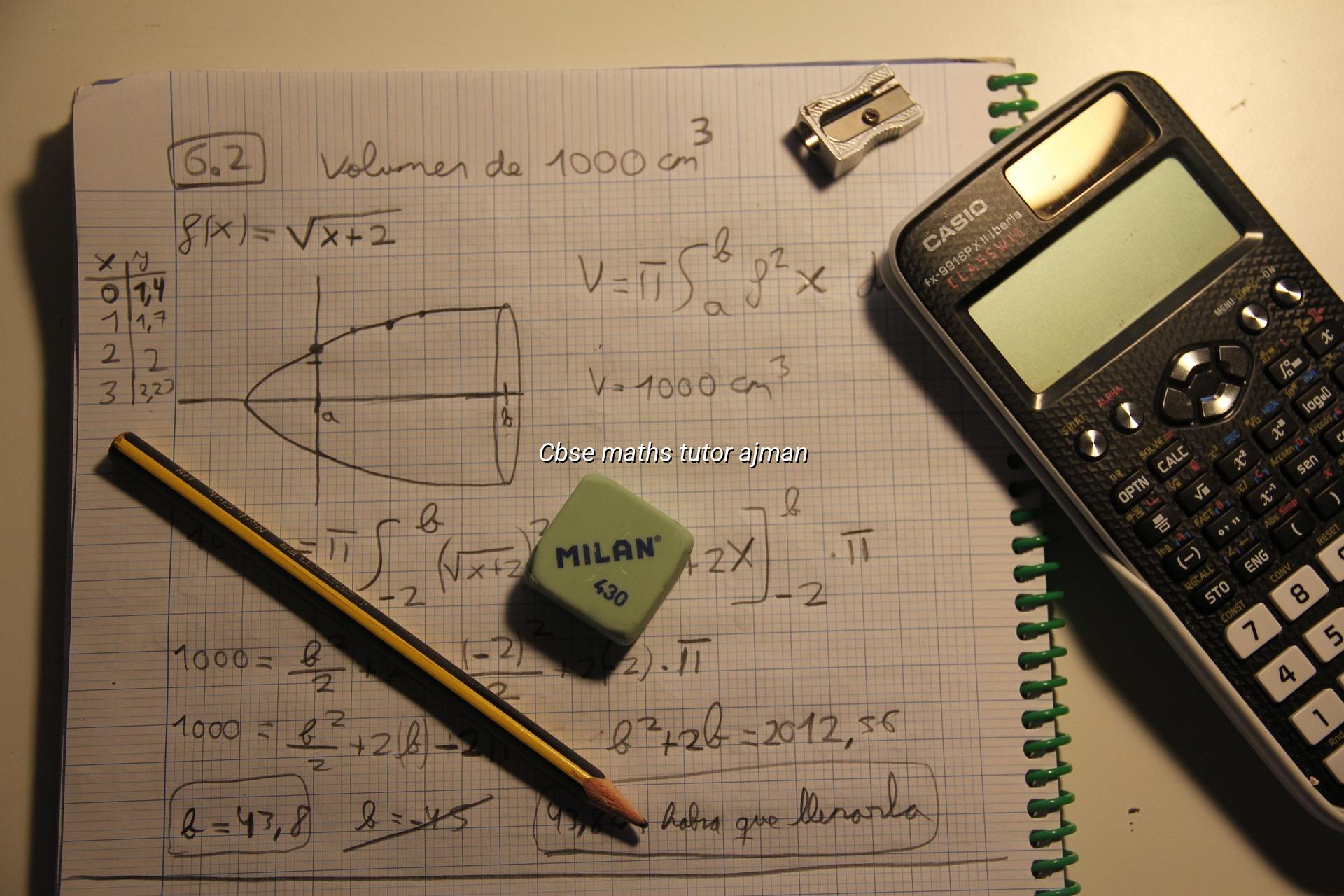
CBSE Maths Tutor Ajman
CBSE maths tutor Ajman is the kind of search parents make when their child can do some of the work, but gets stuck on the steps in between. We work with those exact moments: fractions in Grade 6, algebra in Grade 8, coordinate geometry in Grade 10, and the jump to class 11 or 12 where the pace gets faster. With live one-on-one online lessons, your child gets patient support, clear explanations, and time to ask the questions they usually keep to themselves in class.
At U CAN Math Academy, we teach CBSE mathematics online for students in Ajman and across the UAE, using a calm and structured style that fits school homework, chapter tests, and board exam revision. Dr. Beulah Samli, Ph.D. in Mathematics, leads our approach, and our sessions are built around concept clarity, practice, and regular feedback. If you're looking for focused CBSE maths help without the noise of a group class, you're in the right place.
What CBSE students in Ajman usually need most
Most families who contact us are not asking for random extra practice. They want someone who can explain the CBSE method the way school expects it, especially when marks are lost for small errors in working, sign mistakes, or weak presentation. In Ajman, many students study in Indian curriculum schools and need support that matches NCERT chapters, sample papers, and school timing around the UAE school week.
We see the same pattern again and again. A student may understand the idea of linear equations, then lose marks because the algebraic steps are rushed. Another student may know the formulas for mensuration, but mix up units or forget how to set out a final answer. A good CBSE maths tutor Ajman should notice those habits early and fix them before they become permanent.
Where the struggle often starts
For middle school learners, the trouble often begins with negative numbers, ratios, decimals, and word problems that need translation from English into math steps. By Grade 9 and 10, students face polynomials, trigonometry, statistics, probability, and the kind of question that rewards neat method more than guesswork. In class 11 and 12, calculus, relations and functions, matrices, and vectors demand steady practice, not last-minute cramming.
Why one-on-one teaching changes the pace
A live individual class gives us room to slow down when a chapter is weak and speed up when the student is ready. That matters with CBSE, because one topic often depends on the one before it. If a learner has gaps in basic algebra, we don't just move on to quadratic equations and hope for the best; we repair the base first.
How we teach CBSE maths online
Our lessons are online and interactive. We use Zoom, Google Meet, or Microsoft Teams with a shared digital whiteboard, so the student can watch every step, solve along with us, and keep a clean record of the method used. For many Ajman families, that works better than commuting across town after school or trying to fit tuition around family schedules.
- First class check: We start by seeing what the student already knows from NCERT or school worksheets, so we don't waste time repeating easy parts.
- Concept fixing: We explain the chapter in plain language, then connect it to one worked example and one guided example.
- Practice with feedback: The student solves questions while we watch the method, correct errors, and point out where marks are usually lost.
- Homework and review: We assign focused practice from the same topic and check it in the next session, so the learning stays active.
- Exam preparation: We use timed questions, sample paper patterns, and revision notes before unit tests, half-yearly exams, and board practice.
CBSE topics we cover across Grades 6 to 12
The CBSE syllabus is broad, and students in Ajman need support that matches the school year they are in right now. Some come for foundation work in the lower grades. Others want help with board-level chapters and the pressure that comes with Class 10 or Class 12. We teach all of it online, one-on-one, and we keep the style aligned with the school curriculum instead of drifting into unrelated material.
| Grade / Level | Typical CBSE Maths Focus | How We Help Online |
|---|---|---|
| Grade 6–8 | Fractions, decimals, integers, ratio, algebra basics, geometry | Clear concept building, slower pacing, and guided practice on step-by-step methods |
| Grade 9 | Polynomials, linear equations, coordinate geometry, statistics | Chapter-wise support with homework help and method correction |
| Grade 10 | Trigonometry, quadratics, AP, circles, constructions, probability | Focused board-style revision, timed problem solving, and sample paper practice |
| Grade 11–12 | Relations and functions, calculus, matrices, vectors, probability | Deeper explanation, formula handling, and exam-oriented revision plans |
A few practical habits that help
Students do better when they keep a small mistake notebook and revisit it before the next class. They also need to write full solutions, not just answers, because CBSE rewards method. And yes, regular short practice beats one long weekend session almost every time.
- Use NCERT first: Start with textbook examples and exercise questions before moving to extra material.
- Keep formulas visible: A handwritten formula sheet helps with revision for chapters like trigonometry and statistics.
- Work on presentation: Neat steps, proper labels, and final answers with units matter in CBSE papers.
- Revise weak chapters weekly: Short review sessions stop old mistakes from coming back.
- Practise under time: Even ten-minute timed sets build speed without creating panic.
Common exam boards and school contexts we see in Ajman
Ajman families often want help that fits the school's exact syllabus, because UAE classrooms can include Indian curriculum schools, British schools, and IB schools in the same city. When the student is in CBSE, we keep the lessons tightly tied to NCERT and the patterns used in school assessments. That way the work feels familiar when the exam paper arrives.
Here is a simple way to think about the difference between common school tracks we support in the UAE, especially for students who move between systems or compare options for senior classes.
| Curriculum | Math Focus | Typical Support Need |
|---|---|---|
| CBSE | NCERT method, algebra, geometry, calculus foundations | Chapter clarity, board-style practice, and error correction |
| British | GCSE or A-Level topics with exam-board style questions | Structured problem solving and paper technique |
| IB | MYP or DP topics, reasoning, applications, and extended response work | Concept depth and method accuracy |
| American | Common Core, Algebra, Geometry, SAT, and AP math | Test prep, speed, and mixed-topic revision |
How U CAN Math Academy Can Help
If you're searching for a CBSE maths tutor Ajman families can trust, we offer live one-on-one online classes that fit the student's level, school calendar, and pace of learning. We help with homework, chapter revision, board prep, and confidence building, all without turning the lesson into a rushed group session. You can reach us on WhatsApp or by email at ucanmath100@gmail.com, or book a free demo class through the contact page.
What makes our support practical
Parents usually tell us they want someone who explains the why, not just the answer. That's the part we focus on. In our experience, once a student understands the method behind a chapter, the fear drops quite quickly, especially with topics like trigonometry identities, quadratic equations, and calculus basics.
Frequently Asked Questions
Ready to start with a free demo?
If you want steady, personal CBSE maths support for your child in Ajman, book a free demo and see how a live one-on-one lesson feels. We keep the process simple and the teaching focused.
A strong CBSE maths tutor Ajman families can rely on should make the subject feel more manageable, not more confusing. That's the standard we work to in every lesson, from the first diagnostic session to the last revision class before an exam.
If your child needs patient online support with CBSE maths, U CAN Math Academy is ready to help. We teach clearly, listen carefully, and keep the focus on real classroom needs.