

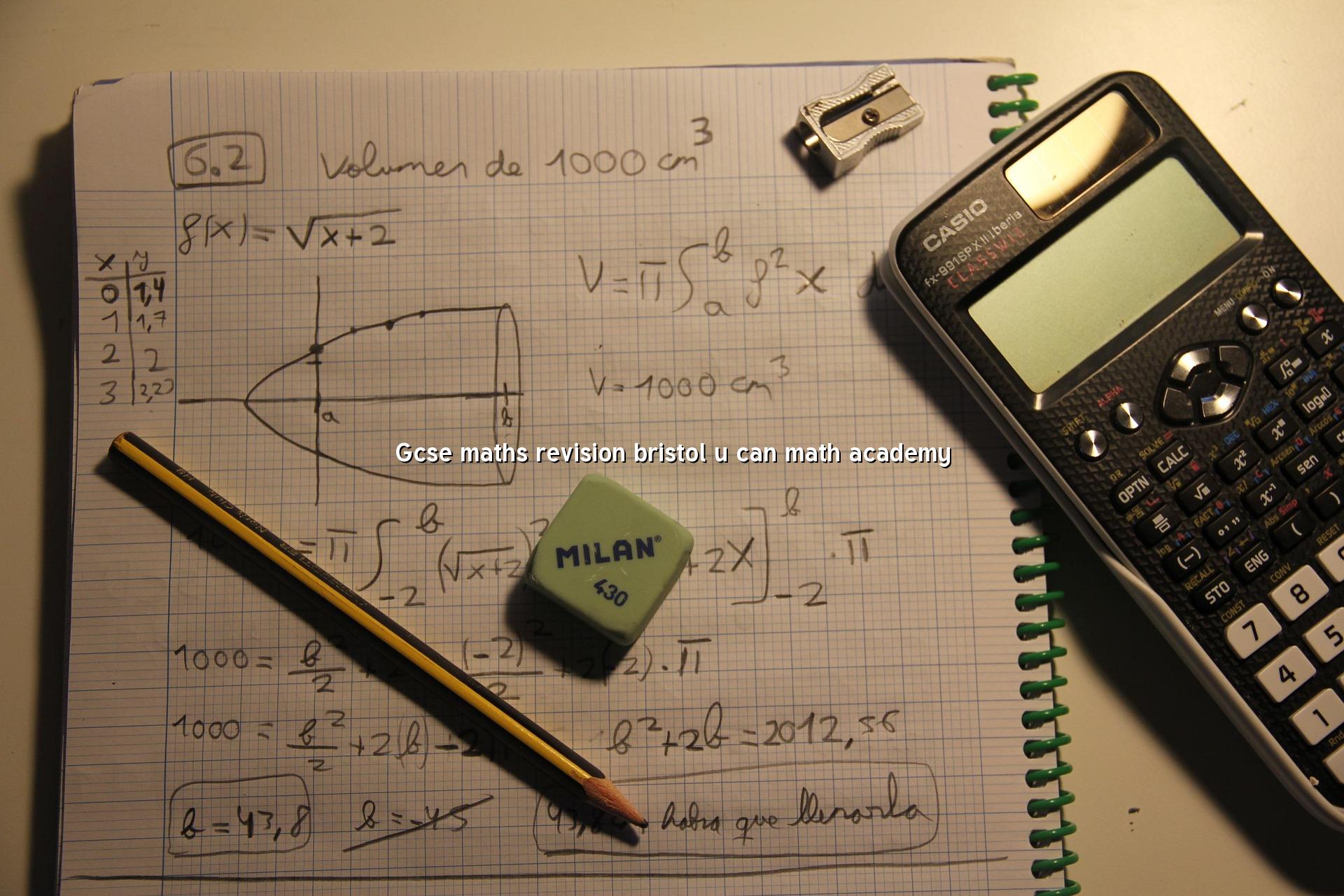
GCSE Maths Revision Bristol | U CAN Math Academy
GCSE maths revision Bristol families ask for usually comes down to one thing: a student has covered the topics, but the exam paper still feels unfamiliar. We help with that gap by turning revision into a clear plan, one topic at a time, in live one-on-one online lessons that fit around school, clubs, and busy evenings.
If your child is in Year 10 or Year 11, the pressure can build quickly around algebra, geometry, ratio, and the calculator paper. Our approach is calm and practical, with the focus always on what the student needs next, not on racing through a worksheet for the sake of it.
What GCSE revision needs to cover
When parents contact us for GCSE maths revision Bristol support, they often mention the same issue: their child can do one type of question at home, then the exam wording changes and the method disappears. That’s normal. GCSE maths papers from AQA, Edexcel, and OCR are built to test understanding, not memorised steps, so revision has to be broader than quick drills.
We keep revision grounded in the actual syllabus. That means number, fractions, percentages, ratio, algebra, graphs, angles, area, volume, probability, and statistics. For higher tier students, we also work through quadratic equations, simultaneous equations, trigonometry, surds, and rearranging formulas, because those areas often decide confidence on Paper 2 and Paper 3.
Why students get stuck at home
At home, revision often becomes a loop of “I know this” and then “I don’t know where to start.” We see that with Bristol students from Year 9 all the way to Year 11. The issue is rarely effort. More often, the student needs a tutor who can spot the exact point where the method breaks down, then rebuild it with a few focused examples instead of a long lecture.
What exam boards expect
AQA likes clear reasoning and neat working. Edexcel often uses familiar ideas in less familiar language. OCR can mix multi-step algebra with geometry or proportional reasoning in the same question. Because we teach online one-on-one, we can tailor the revision to the board your child is taking, and to the gaps they actually have.
A simple revision process that works
Good revision doesn’t mean doing everything at once. We usually build a weekly rhythm that starts with diagnosis and ends with exam-style practice. That way, the student knows what to revise, how to revise it, and how to check whether the method has stuck.
- Step 1: Check the baseline. We begin with a short conversation and a few targeted questions to see which topics are secure and which ones keep slipping, such as fractions, algebra, or circle theorems.
- Step 2: Fix one gap at a time. Instead of bouncing between topics, we work on the weakest area first. That might be rearranging equations, factorising, or interpreting graphs.
- Step 3: Practise exam wording. Students need to recognise how a question is asking the same skill in a different way. We use GCSE-style wording, mark-scheme language, and timed practice.
- Step 4: Review mistakes properly. A wrong answer matters if the student understands why it happened. We look at methods, working steps, and common traps, then repeat the skill in a fresh question.
- Step 5: Revisit after a short gap. A topic needs to come back later in the week. That second look is where recall gets stronger, especially for formulae, angles, and ratio questions.
Topics Bristol GCSE students often revise first
Some topics come up again and again because they sit at the heart of the paper. A student who can handle algebraic manipulation, fractions, and ratio usually finds the rest of the paper far less stressful. Here’s a useful way to think about what to revise and where it tends to matter most.
| GCSE Area | Typical Question Type | Why It Matters |
|---|---|---|
| Number and Fractions | Percentages, rounding, fractions of amounts | Appears early in many papers and supports algebra and ratio |
| Algebra | Expand, factorise, solve equations, sequences | Shows up across both foundation and higher tier papers |
| Geometry and Measures | Angles, area, perimeter, volume, trigonometry | Often carries multi-step marks and clear working |
| Statistics and Probability | Charts, averages, probability trees, scatter graphs | Uses real data and rewards careful reading |
| Ratio and Proportion | Best buys, sharing, scale drawings, direct proportion | Links number skills with problem solving |
Foundation and higher tier need different revision habits
A foundation student often needs steady confidence with core methods and exam language. A higher tier student needs that too, but with more attention on algebraic proof, multi-step reasoning, and questions that mix topics. We adjust the pace accordingly. Some students need one lesson on percentages and then another on probability trees; others need a stretch through trigonometry, circles, and simultaneous equations in a single week.
How we teach online one-on-one
We teach live on Zoom, Google Meet, or Microsoft Teams with a shared digital whiteboard, so the lesson feels active rather than passive. The student can ask questions as soon as they get stuck, and we can correct working in real time. That matters a lot for GCSE maths because tiny errors in signs, fractions, or units can cost marks quickly.
Our lessons are concept-based, which means we don’t just give the answer and move on. We explain the idea, show the method, then ask the student to try it with support. In our experience, that is what helps revision stick after the lesson ends, especially when the student has a test the following week.
- Targeted practice on the exact GCSE board your child is taking.
- Clear explanations for algebra, geometry, and problem-solving questions.
- Homework and assignment help between lessons when a topic needs extra work.
- Flexible online scheduling that works across Bristol, the wider UK, and overseas time zones.
- A calm, one-on-one space where students can ask questions without feeling rushed.
When parents usually reach out
Most parents who call us about GCSE maths revision Bristol support are looking at one of three moments. Sometimes it’s the start of Year 11 and they want a proper plan before mocks begin. Sometimes it’s after a mock paper shows weak spots in algebra or ratio. And sometimes it’s late in the year, when the student knows the content but needs help turning knowledge into exam marks.
We also work with students who have missed lessons because of illness, school moves, or a long gap in maths confidence. Bristol has a wide mix of schools and exam routes, so our job is not to guess. It’s to listen, identify the current level, and build from there without making the student feel behind.
Revision before mocks and the final exam
The weeks before mocks are often the best time to start. There’s enough room to fix weaknesses, and the student can still revisit topics more than once. Closer to the final exam, we narrow the focus to exam papers, mixed-topic sets, and the wording patterns that usually catch students out. That includes the little details, like writing exact values, showing units, and checking whether a calculator is allowed.
How U CAN Math Academy Can Help
If you want GCSE maths revision Bristol support that feels personal, structured, and easy to fit around school, we can help. U CAN Math Academy offers live one-on-one online tutoring with Dr. Beulah Samli, Ph.D. in Mathematics, and we work with students across the UK, including Bristol, as well as families in the US, Canada, and the UAE.
We’ll help your child focus on the topics that matter most, practise exam-style questions, and build real confidence in their working. To book a free demo class, please use our contact page, message us on WhatsApp, or email ucanmath100@gmail.com.
Frequently Asked Questions
Book GCSE Maths Support That Fits Your Schedule
If your child needs steady, focused GCSE maths revision Bristol families can rely on, start with a free demo class and see how the lessons work in practice.
Revision gets easier when the plan is clear and the teaching is personal. That’s what we aim for every day at U CAN Math Academy, and it’s why so many families choose our online one-on-one support for GCSE maths.