

Linear Algebra Tutor Canada
If you’re searching for a linear algebra tutor Canada students can meet online, you probably need help that feels clear, patient, and tied to your actual course. We work one-on-one with students who are facing matrices, vector spaces, eigenvalues, and proofs, and we keep the lesson focused on the exact point where the work gets stuck.
Most Canadian students who reach out to us are in first-year university math, engineering, computer science, or applied science courses. Some want help before a midterm at the University of Toronto, McGill, Waterloo, UBC, Alberta, or a local college; others just want the subject to stop feeling abstract and start making sense.
What students usually need in linear algebra
Linear algebra looks simple at first because the symbols are compact. Then the course asks you to move between row reduction, linear independence, span, basis, dimension, determinants, and linear transformations without losing the thread. That’s the point where many students start guessing instead of reasoning, and guessing doesn’t hold up in a Canadian university exam.
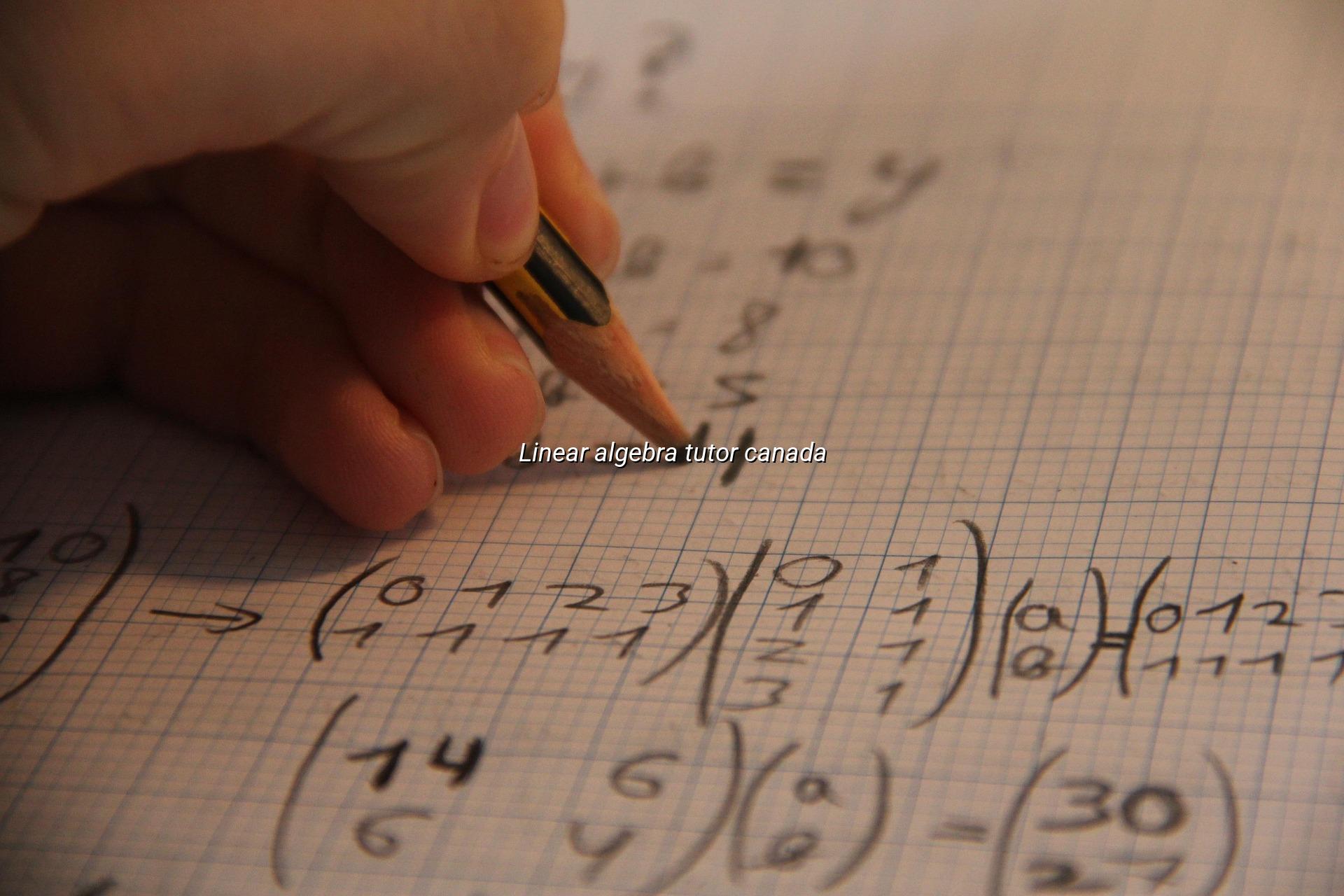
Our approach is to slow the topic down and connect each idea to the next. A matrix isn’t just a table of numbers; it can represent a system, a transformation, or a structure you’ll use again in differential equations, statistics, and numerical methods. When those links are clear, the formulas stop feeling random.
Where the confusion usually starts
A lot of students can do mechanical row operations but freeze when asked to explain why a system has one solution, infinitely many, or none. Others can compute eigenvalues but don’t know what an eigenvector is telling them. We hear this every term, especially from students in engineering math and data-heavy programs.
How we handle proofs and definitions
Proof-heavy sections often trip people up because they try to memorize sentences instead of learning the logic. We build the proof from the definition upward, using short checks at each step. That matters in topics like subspaces, linear maps, orthogonality, and diagonalization, where one missing idea can break the whole solution.
A practical way to study the subject
When we tutor linear algebra, we usually follow a simple order. It keeps lessons efficient and gives you a repeatable method for homework, quizzes, and exams.
- Start with the definitions: check what the course means by vector, subspace, basis, or transformation before touching the exercises.
- Work one example by hand: do the row operations, column checks, or basis test slowly enough that each step makes sense.
- Explain the result in words: say what the answer means, not just what the final numbers are.
- Repeat with a mixed problem: combine two ideas, such as rank with nullity or eigenvalues with diagonalization, so the course feels connected.
- Review with timed practice: use past-paper style questions or instructor worksheets to see where speed breaks down.
Topics we cover for Canadian university courses
Students in Canada often meet linear algebra in Math 101, Math 102, Engineering Mathematics, or first-year science streams. The exact syllabus changes by school, but the core themes repeat. A strong tutor keeps track of the topic order and the notation your professor uses, because one class may write vectors as columns while another emphasizes abstract vector spaces from day one.
| Topic | What it usually covers | Common student challenge |
|---|---|---|
| Systems of linear equations | Row reduction, augmented matrices, consistency | Knowing how to read the reduced form correctly |
| Vector spaces and subspaces | Span, independence, basis, dimension | Turning definitions into a proof or test |
| Linear transformations | Kernel, image, matrix representation | Connecting abstract maps to matrix form |
| Eigenvalues and eigenvectors | Characteristic polynomial, diagonalization | Setting up the right equation and interpreting the result |
| Inner product and orthogonality | Dot product, projections, Gram-Schmidt | Knowing when to project, normalize, or orthogonalize |
Why Canadian students ask for one-on-one support
Large lecture halls move fast. In a 200-person engineering class, the professor can’t pause every time a student is confused by basis or rank. A one-on-one session gives you room to ask the question you were afraid to ask in class, and that alone often changes the way the topic feels the next day.
We also see a lot of students who are good at computation but weak in interpretation. They can finish the exercise set, yet they lose marks on short-answer questions because the explanation is thin. That’s usually fixable with a few focused sessions and better problem structure.
A few habits that make the work easier
If you want to improve in linear algebra, the small habits matter more than long study marathons. A 45-minute session with real concentration usually beats three distracted hours.
- Rewrite definitions in your own words before solving problems.
- Keep a one-page sheet for rank, nullity, span, basis, and dimension.
- Check every answer against the question asked, especially in proof questions.
- Practice with both numeric matrices and abstract vector spaces.
- Ask for help as soon as eigenvalues, determinants, or projections start to blur together.
How linear algebra connects to other courses
This subject doesn’t stay in one corner of the curriculum. In engineering, it turns up in systems modelling and differential equations. In statistics, it shows up in regression and data fitting. In computer science, it supports graphics, machine learning, and coding theory. Students who see those links usually stop treating linear algebra as a memorization task and start treating it like a tool.
That shift matters during exam season. A student preparing for a University of British Columbia quiz, a McGill lab report, or a Waterloo assignment doesn’t need more noise. They need a tutor who can isolate the idea, show the method, and leave them with a clean way to practise the next question on their own.
How U CAN Math Academy Can Help
U CAN Math Academy offers live one-on-one online tutoring for Canadian students who want steady help with linear algebra, from the first row operation to the last proof. We teach with a shared whiteboard, ask you to explain your thinking aloud, and adjust the pace to match your course and time zone.
If you want support before an assignment, a midterm, or a full course retake, we can help you build a cleaner method and more confidence. Call/WhatsApp Chat on WhatsApp or email ucanmath100@gmail.com to book a free demo class.
Frequently Asked Questions
Ready to make linear algebra feel manageable?
Book a free demo class and we’ll work through the exact topic giving you trouble, whether that’s matrices, proofs, or eigenvectors.
If linear algebra has been piling up for a while, you’re not the only one. Once the course starts to make sense, the rest usually moves faster, and that’s where steady support helps most. U CAN Math Academy is here as a live online tutor for Canada, with the same calm, one-on-one attention every student deserves.