

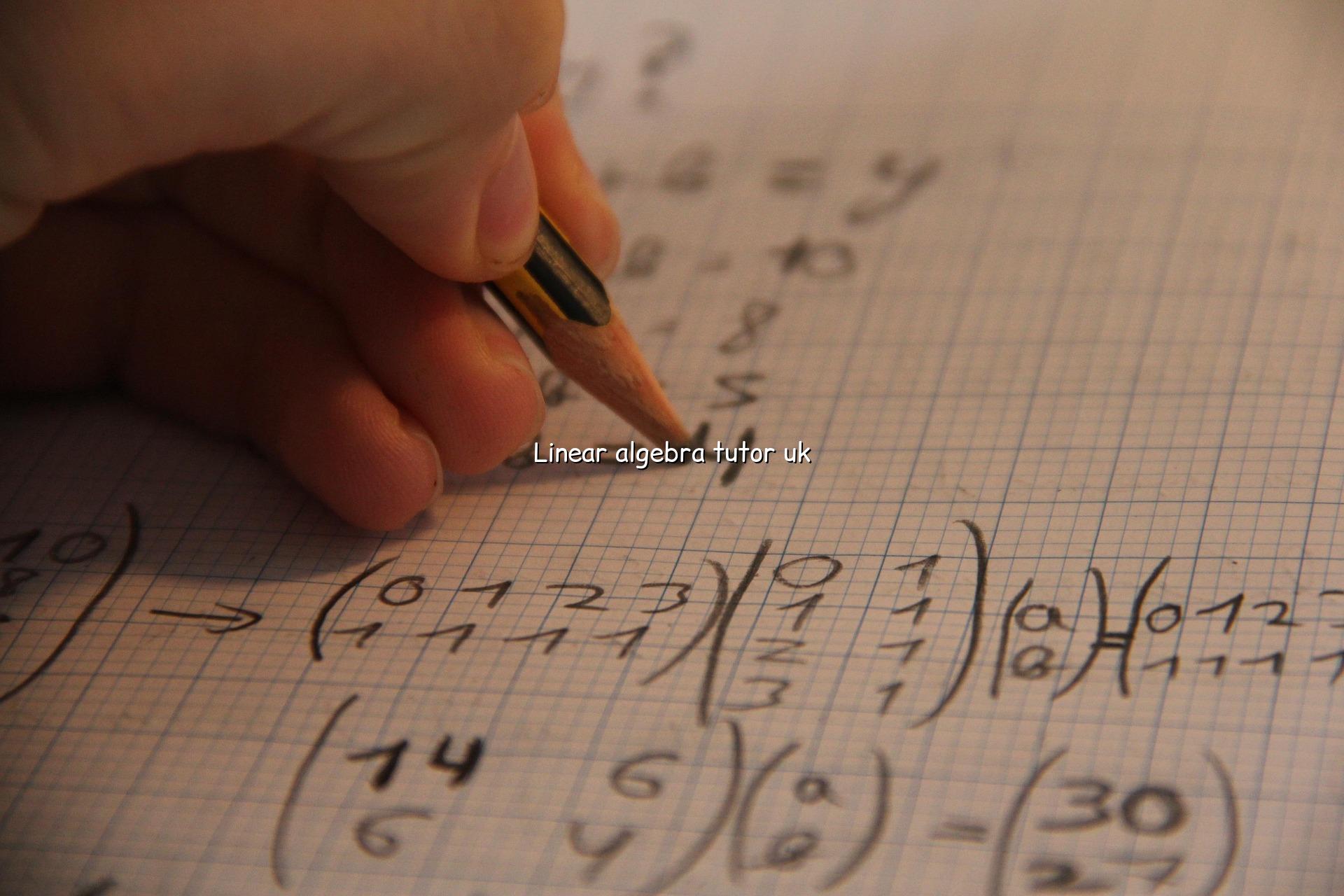
Linear Algebra Tutor UK
If you've been searching for a linear algebra tutor UK students can trust, you're probably dealing with more than a few symbols on a page. Matrices, vector spaces, eigenvalues, rank, and proofs can all feel disconnected until someone explains the logic behind them in plain English.
We work with school, sixth form, and university learners across the UK in live one-on-one online lessons. The goal is simple: make the subject clear, reduce the panic around calculations, and help you practise the exact kind of thinking that linear algebra demands.
Why linear algebra often feels harder than it should
A lot of students first meet linear algebra through matrices, then suddenly meet vector spaces, linear transformations, bases, and dimension. That jump is steep. In our experience, the real problem isn't the content itself; it's that many learners are shown procedures before they understand what the objects mean.
For UK students, this shows up differently at each stage. A-Level Further Maths may introduce matrices and transformations in a fairly compact way, while university modules move fast into abstract definitions and proof. If you're at GCSE level, you may only see the early pieces through algebraic manipulation and graph interpretation, but the same habits matter.
What usually confuses students first
Most parents who contact us mention one of three things: the student can follow class notes but can't start problems alone, the formulas blur together, or exam questions look nothing like the homework. That's normal. Linear algebra rewards pattern recognition, but only after you've seen enough worked examples to notice the structure.
How we keep explanations simple
We begin with meaning, not memorisation. For example, when a learner is working on matrix multiplication, we don't rush past the reason the dimensions must fit. We show why the operation works, where it appears in physics and engineering, and how a small slip can change the whole result.
- Check the topic list first: We start by identifying the exact material, such as systems of equations, eigenvectors, or diagonalisation.
- Spot the missing step: We find the point where your working breaks down, often in notation or method choice.
- Build the idea with one example: We use a short worked problem before moving to harder exam-style questions.
- Practise with feedback: You try similar questions while we correct mistakes in real time.
- Revisit under exam conditions: We finish with timed practice so the method feels familiar, not strange.
UK levels and what we usually cover
A good linear algebra tutor UK families can rely on should adapt to the student's level, not force everyone through the same notes. A Year 12 student preparing for A-Level Further Maths needs something very different from a first-year engineering student working on vector spaces or matrices.
| Level | Typical Topics | How We Help |
|---|---|---|
| GCSE / Higher Tier | Algebraic manipulation, graphs, coordinates, simple matrix ideas | Build the base skills that support later matrix and vector work |
| A-Level Maths | Vectors, transformations, solving simultaneous equations | Strengthen methods and keep working neat enough for marks |
| A-Level Further Maths | Matrices, inverses, determinants, eigenvalues, linear transformations | Connect definitions to exam questions and proof-style reasoning |
| University / Engineering | Vector spaces, basis, dimension, linear mappings, applications | Use clear examples, then move into abstract work step by step |
That table isn't there to look tidy. It's the real split we see every week. A Year 13 student in Manchester revising for Edexcel Further Maths might need exam techniques for matrix inverses, while a university student in London may need help understanding why span and linear independence matter in a proof.
What a live online lesson actually looks like
Our lessons are one-on-one and live, using Zoom, Google Meet, or Microsoft Teams with a shared digital whiteboard. That matters because linear algebra is visual. A matrix can be rewritten, a vector can be drawn, and a transformation can be tracked in front of you instead of hidden inside a long paragraph of notes.
We also keep the pace flexible. Some students want to go slowly through the basics of row operations; others need a fast review before an exam. Since we teach across UK time zones, evening slots work well for school students, and daytime sessions suit university learners with busy timetables.
- Clear notation: We explain every symbol, from vector notation to matrix brackets, before moving on.
- Worked examples: You see the full method, not just the final answer.
- Homework support: We help with set problems, revision sheets, and assignment questions.
- Exam focus: We practise questions from UK-style papers and university modules where relevant.
- Regular feedback: You hear what to fix right away, while the method is still fresh.
How to improve your linear algebra study routine
You don't need a dramatic study overhaul. Small changes work better, especially when the topic already feels dense. The students who settle into linear algebra usually do three things consistently: they keep their notation tidy, they rewrite examples by hand, and they check each step against the meaning of the problem.
A short routine that actually helps
Try starting with one topic per session. If you're on determinants this week, stay there until the calculations feel routine, then move to inverse matrices or eigenvalues. Mixing too many ideas too soon can make the subject feel like a mess of similar-looking steps.
When students tell us they "understand it in class but forget it later," the issue is usually practice spacing. A short review after 24 hours, then another after a few days, makes a bigger difference than one long revision marathon on Sunday night.
How U CAN Math Academy Can Help
We teach linear algebra through live, one-on-one online sessions that fit UK school and university schedules. Dr. Beulah Samli, Ph.D. in Mathematics, works with students on concepts, problem solving, revision, and assignment support, so you can ask the questions that don't get answered in a crowded classroom.
If you want a calm, practical way to improve, start with a free demo class. message us on WhatsApp or email ucanmath100@gmail.com, and we'll help you plan the next step.
Frequently Asked Questions
Start with a clear plan
If linear algebra is slowing you down, we'll help you sort the ideas, fix the method, and practise with purpose.
Linear algebra gets easier once the structure starts to make sense. With the right support, the symbols stop looking random and begin to work together.
That's the kind of progress we like to see at U CAN Math Academy, and it's exactly why UK students keep coming back to us for focused online help.