

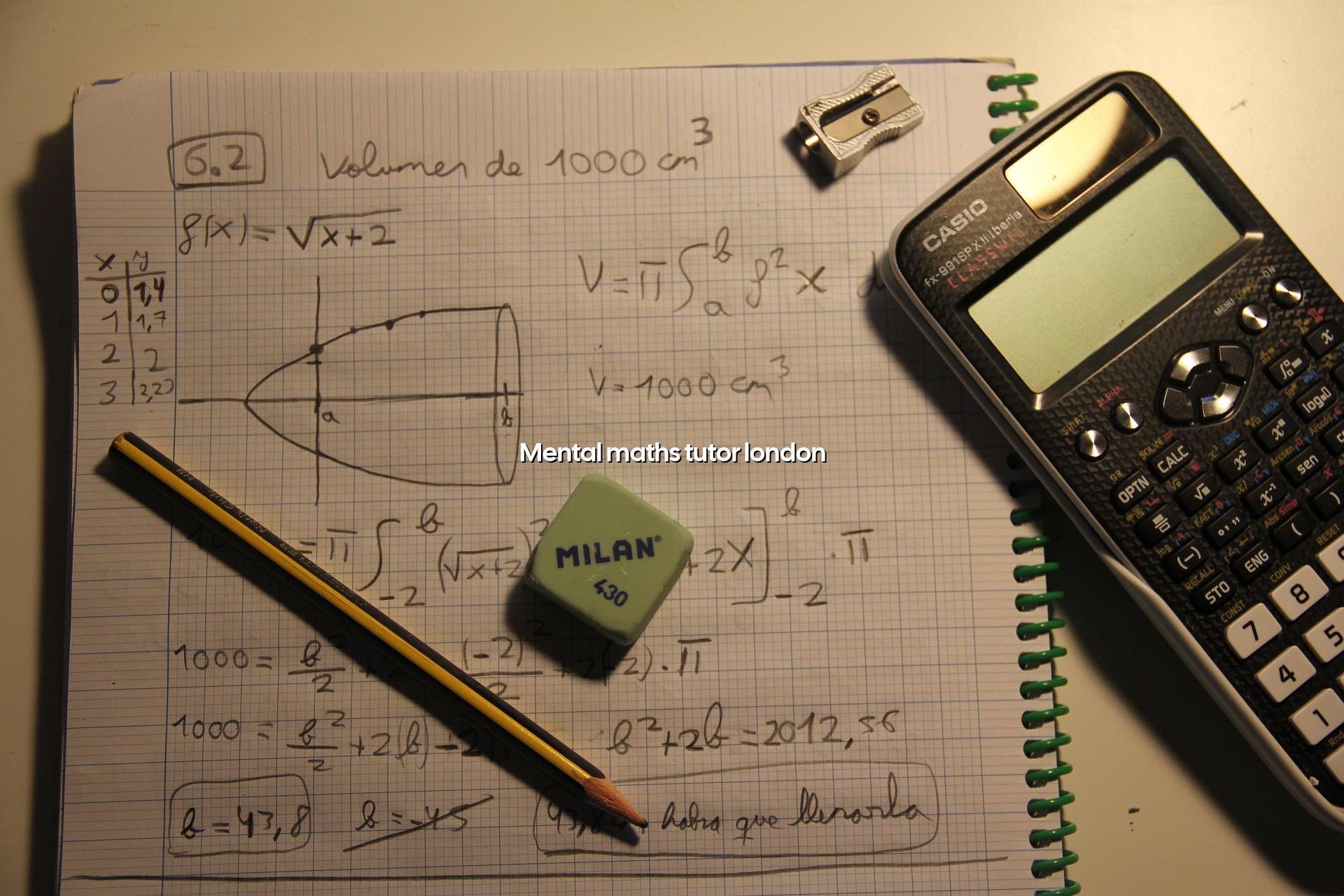
Mental Maths Tutor London
If you’re searching for a mental maths tutor London families can trust, you probably want something very specific: quicker thinking, cleaner arithmetic, and fewer silly mistakes under pressure. We work with students online, one-on-one, so they can answer faster without guessing and without freezing when a question looks short but tricky.
Most parents who contact us about mental maths say the same thing. Their child knows the method in class, but the speed drops in timed work, mental calculations, entrance test practice, or the first few minutes of a GCSE paper. That’s exactly where focused coaching helps, because mental maths is as much about habits as it is about numbers.
What mental maths really needs in daily practice
Strong mental maths is built from small, repeatable skills: number bonds, place value, estimation, multiplication facts, fractions, decimals, percentages, and pattern spotting. In our sessions, we don’t just throw questions at students. We show them how to split a calculation, notice a shortcut, and check if an answer makes sense before moving on.
A student in Year 7 might need help with adding and subtracting negative numbers or rounding quickly. A Year 10 student may be working on percentage change, ratio, or making sense of calculator-free questions in exam style. The method changes with the level, but the aim stays the same: steadier thinking and less hesitation.
Why speed without accuracy doesn’t help
We see this a lot in London schools, especially when students are used to racing through homework. A child can finish a set quickly and still lose marks because they mixed up 0.4 and 4, or forgot that 3/4 of 20 is 15, not 5. Mental maths has to be accurate first. Speed comes after the brain stops second-guessing every step.
How we keep students thinking, not panicking
Live one-on-one lessons let us pause at the exact moment confusion starts. If a student is stuck on 17 × 6, we’ll show one route, then another, then ask them to say the steps out loud. That kind of practice works well on Zoom, Google Meet, or Microsoft Teams because the whiteboard and voice explanation make the thinking visible.
- Start with number bonds: quick recall of pairs to 10, 20, and 100 makes later work smoother.
- Use friendly decomposition: turn 48 + 37 into 40 + 30, then 8 + 7, so the student sees the structure.
- Practise timed bursts: short sets of 5 to 10 questions help build focus without tiring younger students.
- Check by estimation: students learn to spot answers that are clearly too large or too small.
- Say the reasoning aloud: verbalising the steps reduces careless slips and builds confidence.
A simple method that works across London schools
Mental maths isn’t one skill. It changes from primary to secondary, and again when students move into GCSE preparation. In the table below, you can see how we often shape the work depending on age and school stage. It’s useful for families in London because many children move between strong school programmes, after-school homework clubs, and exam prep with very different expectations.
| Stage | Typical focus | What we practise online |
|---|---|---|
| Primary / KS2 | Number bonds, times tables, place value | Quick recall, oral drills, simple fraction and decimal work |
| Years 7–8 | Integers, fractions, decimals, percentages | Mixed mental questions and reasoning steps on the whiteboard |
| Years 9–11 | GCSE-style non-calculator skills | Estimation, ratio, percentage change, algebraic thinking |
| Entrance test support | Speed, accuracy, problem recognition | Timed sets, review of errors, confidence under pressure |
How to build faster calculation habits
If you want your child to improve, the practice has to be regular and short enough to stay manageable. We usually begin with a diagnostic conversation, not a long test. That shows us whether the issue is recall, confidence, working memory, or a weak grasp of the underlying number sense.
- Spot the weak area: find out if the student struggles with times tables, fractions, percentages, or multi-step mental arithmetic.
- Pick one calculation style: use split numbers, doubling and halving, or rounding to nearby values.
- Practise out loud: ask the student to explain why 19 × 5 is easier as 20 × 5 minus 5.
- Repeat in short sets: ten focused questions work better than a long worksheet done once a week.
- Review mistakes immediately: correct the pattern while it’s still fresh, so the same slip doesn’t keep coming back.
Where London students often trip up
A common example is percentage work. Students may know that 10% is easy, but they hesitate on 15% or 12.5%. Once they learn to find 10%, then 5%, then combine them, the question stops looking mysterious. The same thing happens with fractions of amounts and mental division by 3, 4, 6, 8, or 12.
Mental maths for GCSE, 11+, and everyday confidence
For GCSE students, the biggest shift is handling non-calculator questions calmly. They need to estimate, simplify, and avoid messy arithmetic that burns time. For younger students preparing for 11+ or school entrance exams in London, mental maths usually needs to be quicker and more polished, because the test window is tight and the question style changes fast.
We also teach mental maths that helps beyond exams. A student who can work out change, percentages, and basic ratio mentally starts trusting their own answers more. That confidence tends to show up in class discussions, homework, and even in checking calculator work properly instead of accepting the first result that appears on screen.
What parents usually notice first
The first sign is often less resistance. Children stop saying every question is “too hard” before trying it. Then they begin to pause, think, and choose a method. That pause matters. It means the work is moving from panic to process, and that’s where progress begins.
How U CAN Math Academy Can Help
We offer live one-on-one online tutoring with Dr. Beulah Samli, Ph.D. in Mathematics, so your child gets direct attention instead of sharing a lesson with a group. If you need a mental maths tutor London families can book from home, we can tailor the work to UK school topics, GCSE non-calculator practice, and confidence-building arithmetic at the right pace.
Tell us what your child is working on, and we’ll shape the sessions around that. You can reach us at Chat on WhatsApp or ucanmath100@gmail.com, or book a free demo class through our contact page.
Frequently Asked Questions
Ready to make mental maths feel manageable?
Book a free demo class, bring the questions your child finds hardest, and we’ll show you how one-on-one online teaching can make practice feel calmer and more useful.
If you’ve been looking for a mental maths tutor London parents can rely on for focused online support, we’re ready to help. A clearer method, a steadier pace, and the right amount of practice can change how a student approaches every number on the page.