

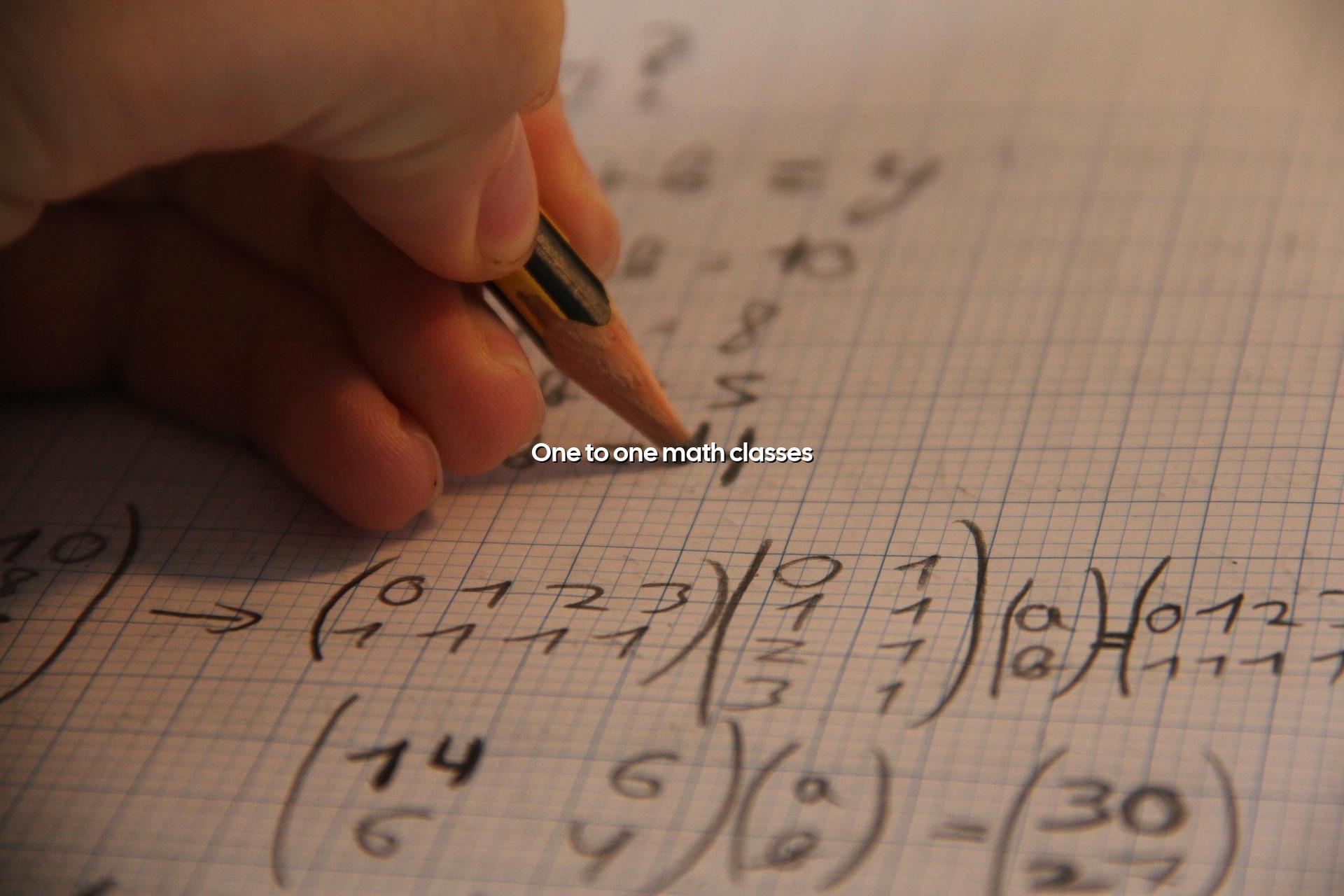
One to One Math Classes
One to one math classes give you a different kind of lesson from the start. The pace fits the student, the questions are direct, and the teacher can see exactly where the confusion begins. That matters a lot when a learner is stuck on fractions in Grade 7, algebra in Year 10, or calculus in first-year university work.
At U CAN Math Academy, we teach live online with real conversation, a shared whiteboard, and steady feedback. Families contact us because they want more than a recorded video or a crowded group class. They want attention, patience, and a tutor who can explain the same idea in a few different ways until it clicks.
Why one-on-one teaching changes the lesson
Most parents who call us say the same thing: their child is fine in class, then freezes during homework. That usually means the student has gaps, not a lack of effort. In one to one math classes, we can spot those gaps quickly. If a student in the US is preparing for Algebra 1, we may back up to integers, equation balancing, and graph reading. If a GCSE learner in the UK is struggling, we can slow down and work through number skills, ratio, and simultaneous equations without rushing the room.
The real value is timing. A student who needs ten extra minutes on a topic should get ten extra minutes. A student who understands quickly should move on. That simple change keeps lessons calm and useful. It also helps with confidence, which is often the first thing to slip when maths has been hard for a while.
What a live session actually looks like
We usually begin with a short check-in and a quick review of the last topic. Then we work through examples together, not in silence. A learner might solve a linear equation on the whiteboard while we watch the steps closely and correct errors right away. For older students, especially those taking AP Calculus, A-Level Mathematics, IB DP, or Canadian provincial math, we often mix theory with past-paper style questions so the method and the exam format stay connected.
Who benefits most from private lessons?
Private lessons help many kinds of students, but a few patterns stand out. Some need regular support through the school term. Others need focused help before a test, a board exam, or a university assessment. We also teach students who are strong in most topics but keep losing marks on one area, like trigonometric identities, functions, vectors, or statistics. In our experience, those students often improve their attitude first; the marks follow the habit.
- Start with the current problem: bring the exact homework, worksheet, chapter, or paper that is causing trouble.
- Check the basics: we look for missing pieces such as arithmetic, fractions, algebraic manipulation, or formula use.
- Teach the method step by step: we explain the concept, model one question, then let the student try the next one.
- Practice with similar questions: we use a few well-chosen problems so the student sees the pattern, not just one answer.
- End with feedback: we note what was learned, what still needs work, and what to review before the next class.
Curriculum focus across the US, UK, Canada, and UAE
Because we work with students around the world, we keep the curriculum in view the whole time. A learner in the US may need Common Core skills, SAT Math, ACT Math, or AP Precalculus. A UK student may need GCSE Maths, IGCSE Maths, or A-Level Mathematics. In Canada, the focus may be provincial high-school mathematics, functions, calculus, or data management. In UAE schools, we often support British, American, IB, CBSE, and ICSE tracks, depending on the school system.
| Student Level | Common Topics | Typical Support Focus |
|---|---|---|
| Grade 6-8 | Fractions, ratios, integers, pre-algebra | Fill gaps, build speed, reduce simple mistakes |
| Grade 9-10 / GCSE / IGCSE | Algebra, geometry, graphs, trigonometry | Method clarity, exam-style practice, confidence |
| Grade 11-12 / A-Level / IB / AP | Functions, calculus, statistics, vectors | Topic mastery, past papers, timed practice |
| University / B.Sc. / M.Sc. | Linear algebra, analysis, differential equations | Concept depth, problem solving, assignment support |
How we keep lessons practical
We do not sit on theory alone. Every topic needs practice, and every practice set needs a reason. For example, if a student is learning quadratic equations, we may work through factoring first, then move to completing the square, then compare that with the quadratic formula. That way the learner understands when each method makes sense. It is the same with calculus or coordinate geometry: the student should know the method, the reason, and the common trap.
- Live explanation on Zoom, Google Meet, or Microsoft Teams with a shared whiteboard.
- Support for homework, chapter revision, board prep, and assignment questions.
- Flexible scheduling for US, UK, Canadian, and Gulf time zones.
- Regular checks so the next class begins with clear direction.
Common mistakes students make in maths
A lot of trouble comes from small errors that repeat. Students rush signs, skip writing steps, copy numbers wrong, or try to memorise without understanding. Another common issue is uneven revision: they practise easy questions and avoid the ones that hurt. We see that often before tests in Edexcel GCSE, AQA GCSE, OCR A-Level, AP exams, and school finals in Canada and the UAE. Private lessons help because the tutor can slow the whole process down and watch those habits closely.
There is also a confidence issue that people do not always name. A learner may know more than they think, but they have learned to expect failure. That changes how they approach the page. One good conversation can reset that. By the second or third session, many students become more willing to try, ask, and correct themselves. That shift matters.
How U CAN Math Academy Can Help
U CAN Math Academy offers live one-on-one online teaching with Dr. Beulah Samli, Ph.D. in Mathematics, for school, university, and advanced maths learners. We keep the focus on the student's own syllabus, homework, and exam needs, so the lesson feels relevant from the first minute. If you're looking for one to one math classes that are personal, steady, and built around real learning, book a free demo class and tell us what your child needs. Phone / WhatsApp: Chat on WhatsApp | Email: ucanmath100@gmail.com
A few signs it may be time to start
If homework takes far longer than it should, if test papers look familiar but still feel hard, or if a student keeps saying, "I knew this yesterday," one to one help can be a good next step. The same is true when a learner is moving into a new exam track, such as GCSE to A-Level, SAT to AP, or school math to engineering mathematics. A short demo often tells us more than a long email thread ever could.
Frequently Asked Questions
Start with a lesson that fits the student
If you want a tutor who listens first and teaches to the learner in front of them, we’re ready to help. Book a free demo class and send us the topic, syllabus, or exam board you want support with.