

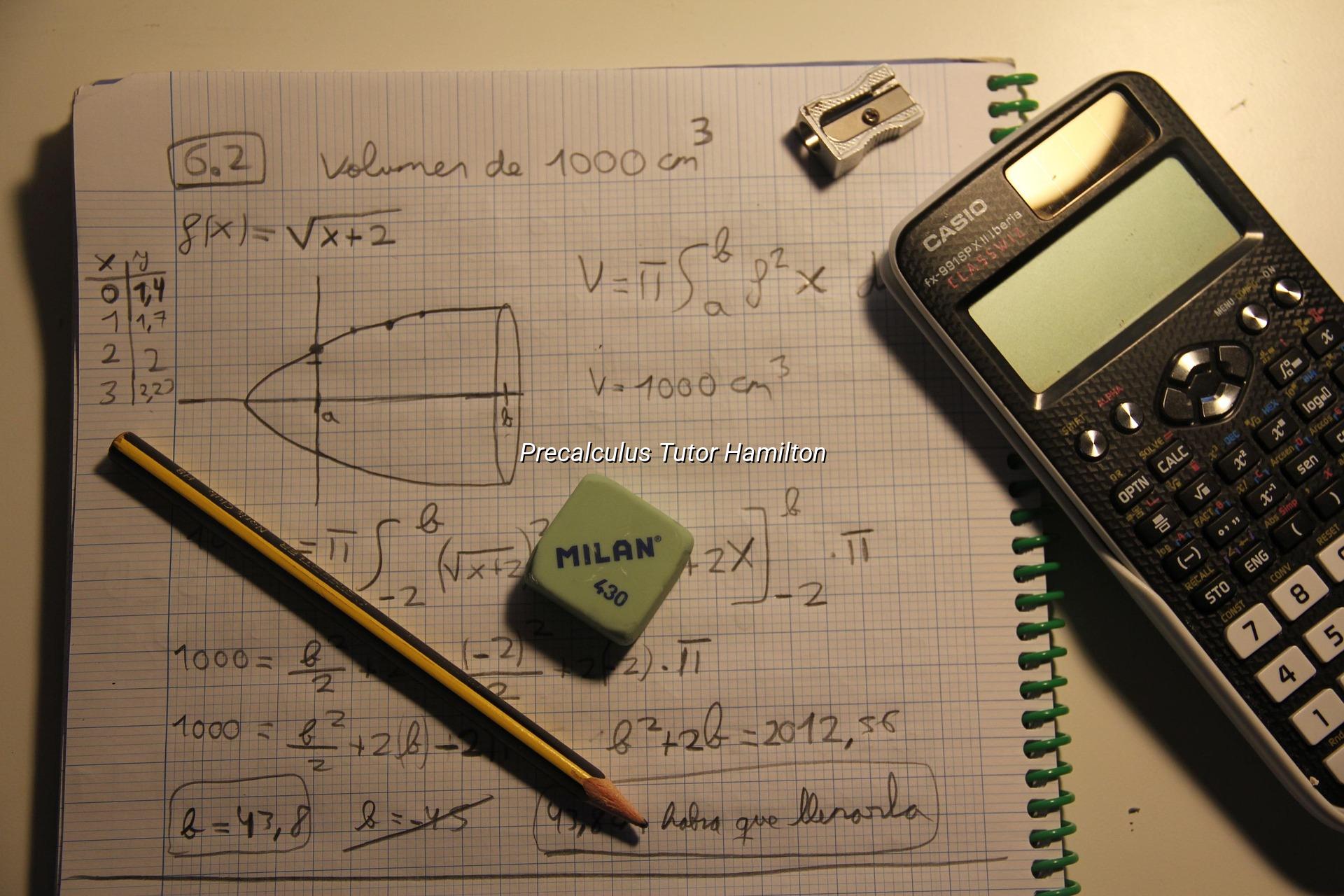
Precalculus Tutor Hamilton
A precalculus tutor Hamilton families can rely on should do more than solve a few homework questions. We work one-on-one online with students who need stronger algebra, better trig fluency, and a calmer way to handle graphing, identities, and functions before calculus starts to feel overwhelming.
Most students who reach out to us are juggling schoolwork, tests, and a topic that suddenly feels bigger than the notes in class. Our live sessions give them room to ask questions, correct gaps from earlier grades, and build the habits that make precalculus more predictable week by week.
What precalculus students in Hamilton usually need help with
When parents ask for a precalculus tutor Hamilton students can meet online, they usually mention one of three things: functions don't feel organized, trigonometry looks like a new language, or assessments move too quickly. That matches what we see all the time. A student may know how to factor a polynomial, yet still lose marks when the same idea appears inside a composite function, a rational expression, or an inverse-function question.
Precalculus connects earlier algebra to calculus ideas such as limits, continuity, and slope. If a learner is shaky on domain and range, asymptotes, radians, unit circle values, or exponential and logarithmic laws, the whole course can feel hard to start. We focus on those exact pressure points, because once the base is stable, the rest is much easier to manage.
Why functions matter so much
Functions sit at the center of most precalculus syllabi. Students in Hamilton schools and online programs often need help reading notation, interpreting transformations, and telling the difference between a graph that shifts, stretches, or reflects. We slow that down and make the pattern visible, then we repeat it with fresh examples until the student can explain it back in their own words.
Trigonometry without the panic
Trig questions tend to pile up fast. A learner may be fine with SOH CAH TOA, then get stuck on identities, exact values, reference angles, or equations on the interval 0 to 2π. In our sessions, we use the unit circle, sketches, and quick recall practice so students stop guessing and start recognizing the structure of the problem.
- Close earlier gaps: strengthen algebra, factoring, exponent rules, and radicals before new work gets added.
- Practice with real questions: work through homework, quizzes, and test-style problems from Hamilton-area and Canadian-style precalculus courses.
- Build graph sense: read transformations, intercepts, asymptotes, and end behavior with more confidence.
- Prepare for calculus: review the ideas that show up again in limits, derivatives, and rate of change.
A simple way we teach precalculus online
Our teaching style is straightforward. We start with the exact question the student is facing, then we trace that back to the earlier skill that caused the confusion. That might mean revisiting function notation, sketching a graph by hand, or checking whether a trig equation is being solved on the right interval. The live online whiteboard helps a lot here, because students can see each step as it happens and make corrections immediately.
We also keep sessions active. A student won't just watch us work. They'll answer short checks, explain choices, and redo a similar problem without looking at the example. That kind of repetition matters more than people think, especially in Grade 11 and Grade 12 precalculus where topics are connected and one missed idea can keep showing up.
Typical lesson flow
- Start with the exact problem: we look at the assignment, practice set, or test review the student needs to finish.
- Find the missing skill: we check whether the trouble is algebra, graphing, trig values, or a mix of all four.
- Teach the idea simply: we explain the concept in plain language and use a worked example on the shared board.
- Practice without support: the student tries a similar question alone while we watch and step in only when needed.
- End with a short review: we note what to practice next so the next session starts with a clear target.
Precalculus topics we cover and how they fit together
A lot of families want to know which parts of precalculus we can teach online. The short answer is most of it, and we tailor the pacing to the course outline the student is actually following. Some Hamilton students are in a provincial-style Canadian course, while others are taking a US-based class through an online school, a private school program, or an international pathway.
| Topic Area | What Students Usually Need | How We Help in Session |
|---|---|---|
| Functions and graphs | Domain, range, transformations, inverse functions | We sketch, compare, and interpret graphs step by step |
| Trigonometry | Unit circle, identities, equations, radians | We build memory with patterns, not random memorization |
| Exponential and logarithmic functions | Growth, decay, log rules, solving equations | We connect rules to graphs and practical examples |
| Sequences and series | Arithmetic and geometric patterns, sums, notation | We slow the notation down and practice reading each symbol |
| Precalculus for calculus readiness | Limits, continuity ideas, slope, interval thinking | We review the bridge topics that show up again in calculus |
How to choose the right support for this course
If you're comparing options for a precalculus tutor Hamilton students can meet from home, look at the teaching method first. Some tutors jump straight to answers, which can help for a night or two but doesn't fix much. A better fit is someone who asks why the error happened, then teaches the missing piece in a way the student can repeat later on their own.
It also helps to choose someone who can work across time zones. Our students come from Canada, the US, the UK, and the UAE, so we often schedule around evenings, weekends, and school breaks. That flexibility matters when a student has a math test on Thursday and hockey practice, band, or another class right after school.
Signs the student is ready for focused tutoring
We usually suggest tutoring when homework time turns into guessing time, or when a student can do one type of problem but not a similar one with a small twist. Another common sign is test anxiety tied to specific units like trig equations or function composition. In those cases, a few structured sessions can make the course feel less chaotic.
How U CAN Math Academy Can Help
At U CAN Math Academy, we teach precalculus online one-on-one with Dr. Beulah Samli and a concept-first approach that keeps the student active. We don't rush through pages of questions; we work through the ideas behind them, then practice until the method feels familiar. If you need a precalculus tutor Hamilton families can reach from anywhere in Canada or abroad, we're ready to help.
You can book a free demo class, then decide if the pace and teaching style feel right for your child or for you. Call us at Chat on WhatsApp or email ucanmath100@gmail.com.
Frequently Asked Questions
Ready to make precalculus feel manageable?
Book a free demo class, meet us online, and see how one-on-one teaching can help your student get clearer on the topics that matter most.
If precalculus has started to feel messy, the fix is usually a better explanation and a little more structure. That's where we come in, and it's why so many families look for a precalculus tutor Hamilton students can meet online without adding more stress to the week.
With U CAN Math Academy, you get live one-on-one support, clear teaching, and flexible scheduling that works across Canada and beyond. If you're ready to start, we'd be glad to talk.