

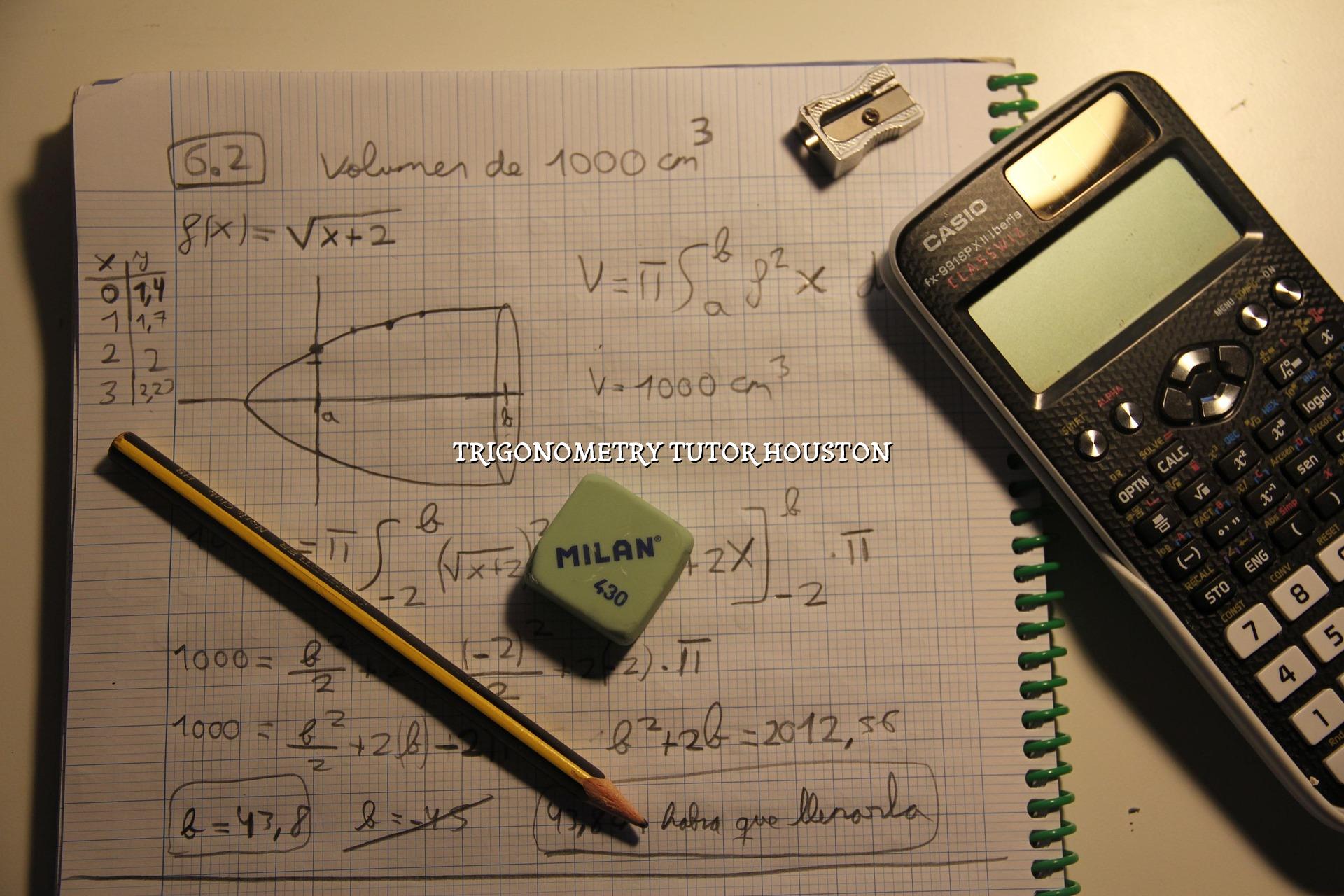
Trigonometry Tutor Houston
If you’re searching for a trigonometry tutor Houston families can trust, you probably already know the pattern: the student can do a few homework questions, then the test shows up and the triangle problems, unit circle values, and graph shifts all look different. We work online with one student at a time, so the lesson starts from the exact point where the confusion begins.
At U CAN Math Academy, we help students in Houston and across Texas build real understanding of trigonometric ratios, inverse trig, identities, radian measure, and function graphs. That means less guessing, fewer memorized shortcuts that fall apart, and more confidence when classwork comes from Algebra 2, Precalculus, AP Precalculus, or AP Calculus AB.
Why trigonometry feels harder than algebra
A lot of Houston students tell us trigonometry feels like a new subject even though it sits on top of earlier math. That’s because it mixes geometry, algebra, and function thinking in the same chapter. One day it’s a right triangle. The next day it’s a sine curve on a coordinate plane, and then suddenly the class is asking for exact values like sin 30° or cos 45° without a calculator.
In our experience, the trouble usually starts with notation. A student may know the ratio opposite over hypotenuse, but still freeze when the problem switches to radians, reference angles, or identities such as sin²x + cos²x = 1. A good trigonometry tutor Houston students can meet online should slow that down and show how every piece connects.
The topics students usually need first
We usually begin with the basics: angle measure in degrees and radians, the unit circle, SOH-CAH-TOA, and the six trig functions. After that, we move into graphing sine, cosine, and tangent, because many students at this stage are also preparing for standardized exams that test interpretation, not just calculation. If the class is in Texas, we also align with the school pace so the tutoring supports what the teacher assigned that week.
Where mistakes usually show up
The same three slips come up again and again: confusing opposite and adjacent, mixing degrees with radians, and using identities without checking the domain. We also see students copy signs incorrectly in different quadrants. Once that happens a few times, the whole chapter can feel unstable. It isn’t. It just needs a cleaner method.
- Unit circle practice: build exact values for special angles before moving to harder problems.
- Identity checks: verify each step instead of trusting memory alone.
- Graph reading: read amplitude, period, phase shift, and intercepts directly from the graph.
- Word-problem setup: convert height, distance, and angle questions into a triangle model first.
How we teach trigonometry online one-on-one
Our lessons are live and interactive. We use Zoom, Google Meet, or Microsoft Teams with a shared digital whiteboard, so students can work through each step with us instead of watching a recorded lesson. For many learners, that immediate feedback changes everything. A question that felt too small to ask in class gets answered right away.
We’ve found that one-on-one sessions work especially well for trigonometry because the subject is cumulative. If a student misses the logic behind radians in week one, graph transformations in week three will feel messy. We clear those gaps in order, not by jumping around.
A simple method that actually helps
Most students improve faster when they follow a repeatable process. We use a step-by-step format in tutoring, and parents like it because they can see what’s being done each week.
- Check the foundation: confirm whether the student is solid on right triangles, special angles, and algebraic manipulation.
- Teach the meaning: explain what the function, ratio, or identity is really saying before solving.
- Work a sample together: solve one problem slowly, naming each choice as we go.
- Move to guided practice: let the student try a similar problem while we correct slips in real time.
- Review with a short check: finish with a quick recap so the student remembers the pattern for homework or the next test.
Houston school and exam needs we commonly see
Houston has a wide mix of school paths. Some students need help with Texas high school Algebra 2 and Precalculus. Others are taking AP Precalculus or AP Calculus and need trigonometry to feel automatic before the exam. We also see students from international programs in the city, including IB Diploma math and GCSE or A-Level families who want a tutor that can match the lesson to the syllabus.
Because we teach online, time zones are easier to manage than with a fixed local center. A student in Houston can meet after school, and families with relatives abroad can still keep the same weekly lesson rhythm. That matters more than people expect. Math improves when the schedule stays steady.
| Level | Typical Trigonometry Focus | How We Support It |
|---|---|---|
| Algebra 2 | Trig ratios, right triangles, basic graphs | Builds early confidence and clears missing algebra skills |
| Precalculus | Unit circle, identities, transformations, inverse trig | Connects formulas to graphs and exam-style questions |
| AP Precalculus | Functions, periodic behavior, modeling | Focuses on explanation, accuracy, and problem structure |
| AP Calculus AB | Trig derivatives, trig limits, radians | Strengthens the trig needed before calculus methods begin |
| IB / A-Level / GCSE | Trig identities, equations, graph features | Matches the pace and style of the student’s syllabus |
What a strong session looks like
A good trigonometry lesson shouldn’t feel like someone reading notes at you. We want the student talking, solving, correcting, and explaining back. If the question is about a triangle, we sketch it. If it’s about a graph, we trace the period and amplitude. If it’s about identities, we test the left side and the right side carefully.
That kind of work is especially useful before unit tests, semester finals, SAT Math, ACT Math, or AP-style assessments. One student may need just three sessions to clean up a few topics. Another may stay longer because the class has moved into harder identities and inverse functions. We adjust to the learner, not the other way around.
Small habits that help at home
We often tell students to keep a tiny trig notebook. Nothing fancy. One page for special angles, one for identities, one for graph features, and one for common mistakes. If the notebook is short enough to review before class, it gets used. If it turns into a binder, it usually doesn’t.
How U CAN Math Academy Can Help
If you need a trigonometry tutor Houston students can meet online without travel or scheduling stress, we’re ready to help. Dr. Beulah Samli leads the academy with a clear, patient teaching style, and we keep lessons focused on the exact topic your child is facing this week. For a free demo class, message us on WhatsApp or email ucanmath100@gmail.com, and we’ll set up a time that works.
A steady plan for better understanding
We start with a short diagnostic conversation, then build a plan around the student’s current class, textbook, and exam timeline. Some students need help with one chapter. Others need regular support across the semester. Either way, the goal is the same: make trigonometry feel manageable enough that homework, quizzes, and test prep stop taking over the week.
Frequently Asked Questions
Ready to make trigonometry clearer?
Book a free demo class and see how our one-on-one online lessons can help your student work through triangles, graphs, and identities with less stress.
Trigonometry gets easier once the student sees the structure underneath the formulas. With the right support, those unit circle pages and graph questions stop feeling random. If you want a trigonometry tutor Houston families can meet online, U CAN Math Academy is ready when you are.